
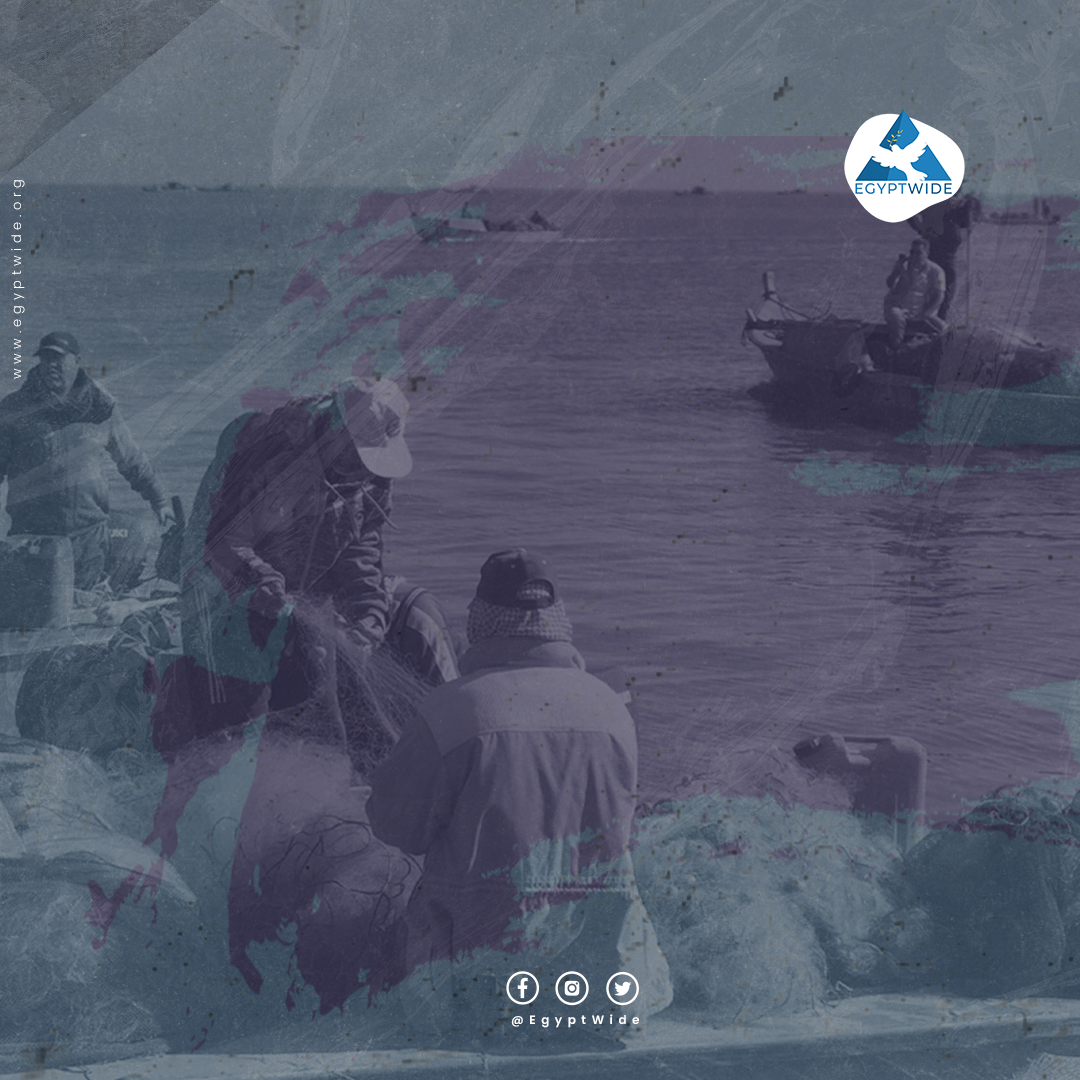
EgyptWide for Human Rights announces the publication of its new report, “Troubled Waters: the Human Rights Cost of Military-led Enterprises in Egypt’s Fishing Sector”. The report documents how military-led fishing and aquaculture enterprises established between 2017 and 2020 have led to an unprecedented deterioration of socioeconomic conditions among local communities in Kafr el-Sheikh, Alexandria, and Damietta, amidst record numbers of arbitrary arrests and human rights violations.
Purportedly intended as a governmental measure to relaunch local fish production and decrease poverty and unemployment, the fishing and aquaculture enterprises established in Lake Ghalioun, Lake Burullus, Lake Manzala, and Lake Mariout in Egypt severely aggravated the living conditions of local communities, traditionally relying on fishing as a primary or sole source of sustenance. Following the creation of the military-run enterprises, locals were denied access to traditional fishing sites without any prior consultation, and started facing increasing, largely arbitrary, bureaucratic constraints to the renewal of fishing licenses. No compensation was offered for the loss of income, and those who tried to maintain fishing licenses became entrapped in spirals of debt, often leading to imprisonment. The sharp deterioration of living conditions pushed many to resort to informal or low-income jobs or attempt to migrate irregularly in search of better opportunities. Several children dropped out of school to search for employment to support their families.
Local fishers also became the target of a large-scale ongoing campaign of arbitrary arrests under the pretext of violating new fishing regulations or posing a threat to national security. Between March 2020 and July 2024, at least 140 fishers were arrested and detained on similar charges, often in completely inadequate or inhumane conditions, while some were also subjected to enforced disappearances. In most cases, the authorities presented no evidence in support of the charges filed against them, and the defendants were tried in military courts despite their civilian status and the alleged crimes' civilian nature.
Combining policy analysis, the documentation of human rights violations, and interviews with residents, the report sheds light on the true human cost of army-led development projects in Egypt, uncovering the nexus between the consolidation of untransparent, authoritarian economic governance and rising poverty levels among the most fragile strata of the population. The human rights violations documented in this report do not represent isolated incidents, but rather exemplify the predatory and unsustainable nature of the Armed Forces’ activism in the Egyptian economy.
Our research also shows that military dominance in the economy produces macro-level distortive effects, aggravating the volatility of the Egyptian economy and driving unsustainable borrowing practices.
The report is available in Arabic and English.


.png)


